

Events

- This event has passed.
Fellow Seminar: Oath-Taking and Oath-Breaking in Byzantium
28 January 2021 @ 16:30 - 18:30
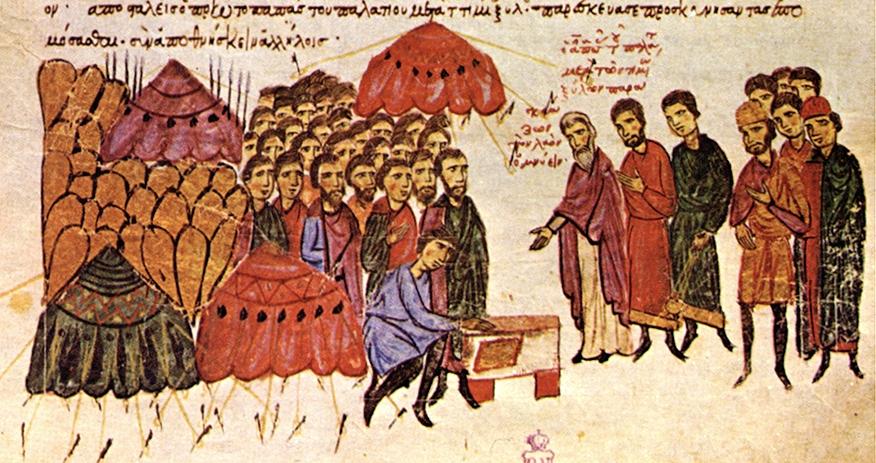
Dr. Savvas Kyriakidis will present his research under the topic:
Oath-Taking and Oath-Breaking in Byzantium
on 28 January, 2021 (Thursday) at 16:30 h.
Moderated by Vladimir Nakov
Abstract
Oaths were one of the main mechanisms that sustained the legal, economic and political structure of Byzantium. They played an important role in the cultural life of the Byzantine empire. The first part of this paper discusses the religious objections to swearing as they are expressed by early Christian and Patristic authors in the fourth and fifth centuries. Authors such as Gregory of Nazianzus and John the Chrysostom followed the New Testament’s rejection of oaths, opposed what they considered excessive use of swearing and claimed that oaths do not prove the reliability of a person.
The second part of this presentation examines the description of oaths in law collections. The sixth-century Justinianic laws and the ninth-century Basilica describe in detail the large variety of oaths that were sworn in Byzantine courts and oath rituals. Moreover, collections of decisions such as that of the Archbishop of Ohrid Demetrios Chomatenos provide important information on the use of oaths court and on the social background of those who swore.
The next part of this paper focuses on the use of alternatives to swearing. The thirteenth century saw the increasing appearance of the ordeal by hot iron and the threat of excommunication as replacement to oath rituals. I discuss the debate regarding the origins of the introduction of these customs to Byzantium and the reaction of Byzantine legal authorities.
The last part of this presentation discusses the concept of conspiracy in Byzantium. Emperors were wary of any type of oaths beyond their control. According to the eighth-century law collection Ecloga, anyone who forms a faction or a conspiracy against the emperor should be punished by death. Byzantium did not see the development of sworn associations similar to those of Western Europe. Nevertheless, all major conspiracies and rebellions against the throne involved the exchange of oaths between their leaders.
Short Bio: Savvas Kyriakidis received his PhD from the University of Birmingham. He has been a post doctoral Fellow at Princeton University and twice a research fellow at the Research Centre for Anatolian Civilizations at Koc University in Istanbul. After spending four years as a Research Fellow at the University of Johannesburg, he received research fellowships from the New Europe College at Bucharest and from the Dumbarton Oaks Research Library at Harvard University. He has taught at Sabanci at Koc Universities in Istanbul, at the Open University of Cyprus and at the Open University of Greece.